Paul Emmitt on why clean energy from thermal chemical recycling is a technology worth embracing
With two of the most pressing challenges facing society today, namely those of reducing the tsunami of plastic waste polluting the planet and the need to decarbonize, there is a growing need to eliminate those plastics which are non-recyclable from the environment whilst at the same time minimizing CO2 emissions that result from this.
Currently such plastic and other hard to abate non-recyclable waste ends up being sent to landfill, incinerated, or exported. Landfill is becoming increasingly unavailable, expensive, and environmentally problematic. Exporting waste simply passes the problem somewhere else and is quite rightly coming under scrutiny. Incineration also presents problems with significant CO2 emissions if not CCS equipped as well as producing a waste that can contain heavy metals and dioxins.

Traditional recycling is also problematic, with much of our plastic being either uneconomical to recycle or ‘contaminated.’ Most recyclable plastic can only be recycled once or twice and is currently more expensive than virgin material.
Consequently, there is an immediate need for alternatives to all the above, aptly highlighted by the fact that in the UK alone 76 percent of total plastic waste is not recycled, and 55 percent of waste is non-recyclable.
A clean and effective solution
An attractive and emerging solution to these issues is the advanced thermal chemical recycling of waste by pyrolysis or gasification to produce clean energy in the form of syngas (synthetic gas similar to natural gas) and hydrogen.
This is not without technical challenges in terms of controlling the chemical reactions to produce the necessary outputs and to do so with consistency, efficiency, and ultra-low CO2 emissions, but these have largely now been surmounted.
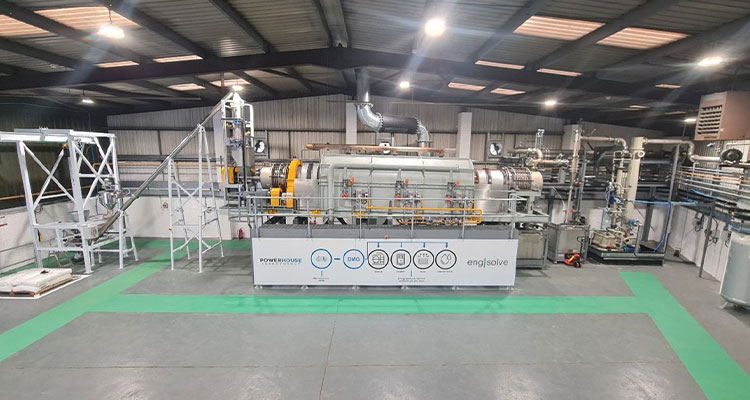
At PowerHouse Energy, where we have been working on these challenges for several years, we’ve recently developed and launched a proprietary and patented process called DMG® (Distributed Modular Generation).
The technology is based around a rotating kiln system with the ability to cross the divide between pyrolysis and gasification. Feedstock is heated to around 1000ºC in the absence of air or treated with an oxidizing agent to thermo-chemically transform waste into energy, with the technical expertise being in the precise control of the heat, feed, and flow of the system.
The result has been the ability to convert a wide range of unrecyclable plastics and other contaminated non-recyclable waste into a consistent and controllable syngas, and if required, 99.999 percent purity hydrogen. Importantly, any excess carbon is sequestered by the generation of a solid carbon rich residue, rather than being emitted, which as a product also has commercial value.
Affordable, efficient, sustainable, responsible
There are many benefits of advanced thermal chemical recycling technology beyond reducing unrecyclable plastic and creating ultra-low carbon energy.
Firstly, the efficiency of the process, which typically uses high calorific waste, makes it a commercially viable one. As an example, a 40-ton-of-waste-per-day DMG® system can produce enough syngas every day to power approximately 10,000 homes at a competitive price, or produce three tons of hydrogen, enough to power 120,000 HGV kilometers, and for less than the current UK CfD strike price for H2.
Furthermore, the range of waste that can be used as feedstock is very broad, examples being contaminated waste, mixed non-recyclable waste, biomass, tires, and automotive shredder residue.
The technology also enables energy to be produced on a distributed basis, due to it being applied at a relatively small plant size. As an example, PowerHouse Energy’s 40-ton-per-day DMG® system requires a 2.5-acre footprint to operate, and so can be located near the source of the waste or where the energy is required.
Applications are numerous, such as alongside Energy from Waste incinerators, where it improves efficiency of existing waste management practices, and in off-grid environments where waste must be exported and energy (normally fossil fuel) is imported, such as in mining and quarrying.
Other sectors we are already seeing interest from include power generation and supply, packaging, consumer products, automotive, tires, and data centers.
In terms of access to feedstock, taking the UK as an example, around four and half million tons of plastic waste is produced annually, of which roughly 76 percent is not recycled, which alone ensures a reliable feedstock source for the foreseeable future.
A commercial and pragmatic way forward
I am not suggesting this is a panacea to dealing with the enormity of the global plastic waste problem; it will require embracing other similar and emerging technologies such as solvent extraction and enzymatic recycling as well.
However, as a pragmatic and commercially viable technology, advanced thermal chemical recycling is now ideally placed to make a significant contribution to reducing non-recyclable waste, especially plastic, producing a clean source of energy and help with the push towards a truly circular economy. In my view, pyrolysis and gasification are technologies well worth embracing, from both an environmental and commercial perspective.
Paul Emmitt
Paul Emmitt is the CEO of PowerHouse Energy Group Plc, with more than 30 years of experience driving infrastructure delivery, engineering innovation, and corporate transformation. His career spans plc board leadership, entrepreneurial growth, and internal operations, with a consistent focus on scaling technology, delivering capital programs, and creating long-term value in regulated and industrial sectors.
